Sectors: furniture makers
Made-to-order furniture is sold before it is made.
A table, sofa or bed is chosen from the maker's sizes, woods and fabrics. It is built after the order. In Specify, a customer chooses within what the workshop makes. They see how long it takes to make.
What makes it hard to sell, and how Specify is built for it
Each piece is built after the order, from choices the customer makes online. Each problem is set beside how Specify is built for it.
In the trade
The delivery date is a promise
Before an online order, the customer must be told when the piece will be delivered. If that date passes, the customer may set a last deadline and then cancel. When dates slip, customers buy something in stock instead.
In Specify
A make time for each choice
Each wood, fabric or finish can carry its own time to make. The longest of the customer's choices sets the estimate. The customer sees the working days to make before ordering, and shipping comes on top.
In the trade
Only a size the customer gives is exempt
EU law gives a 14-day right to change one's mind. Goods made to the customer's own specification are left out of it. The Commission's example is furniture made to the customer's measurements. A colour or fabric picked from the maker's catalogue is not enough. The Danish and Swedish consumer authorities read it the same way.
In Specify
Sizes within the workshop's limits
A customer types a length or a width within the workshop's smallest and largest size. A size outside them is refused as it is typed. It is checked again before the order is placed.
In the trade
A one-person workshop makes a regulated product
Since December 2024, EU product safety rules apply to every maker, whatever its size. Before a piece is sold, the maker assesses its risks. The maker keeps technical documentation for ten years.
In Specify
Only what the workshop will make
A combination the workshop will not make is refused before anyone pays. So the website offers only what the workshop has chosen to make. The customer reads why, and the maker keeps the reason.
In the trade
Most makers are a few people
In 2023, nine in ten of the EU's furniture makers had fewer than ten people. In Denmark in 2024, 462 of the trade's 622 workplaces had fewer than ten. In Sweden in 2022, two in three furniture companies had no employees.
In Specify
Every choice in one request
A customer chooses a length, a width, a wood and the details. They can describe the table in words. Or they ask for something the workshop does not list. It all reaches the workshop together, with every choice made.
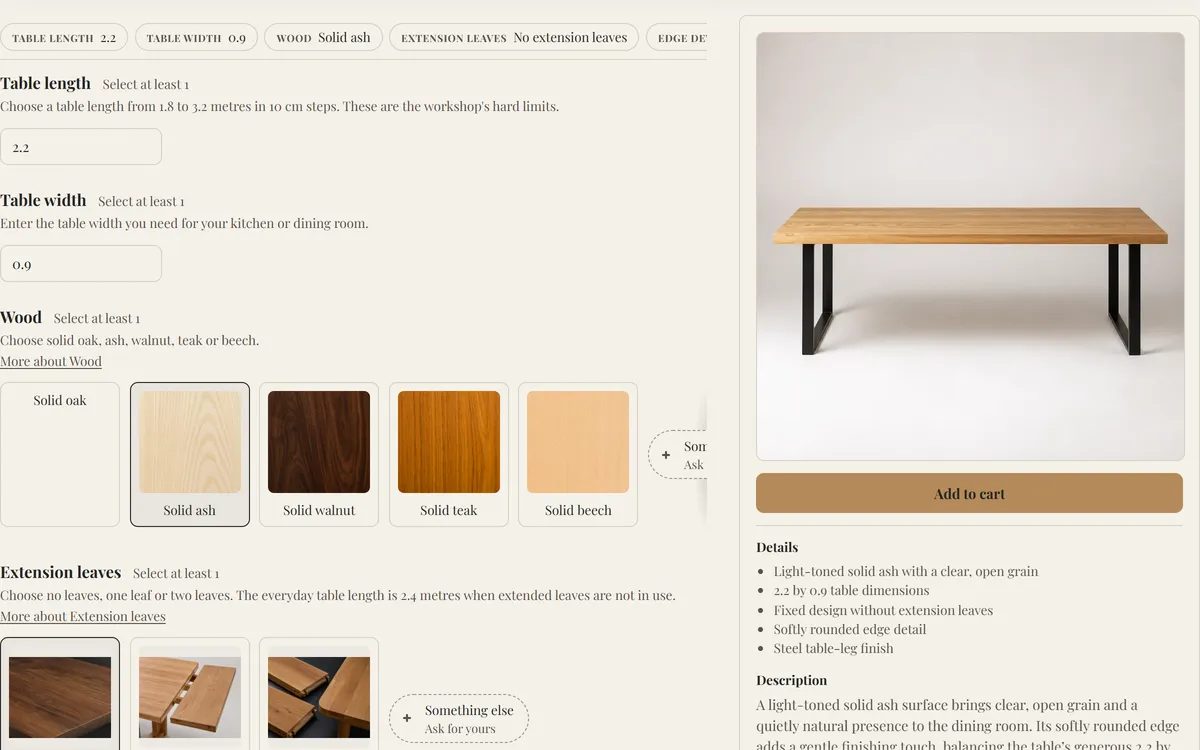
From the table demo store, which we built. The length, width, wood, leaves, edge and legs are chosen. Every choice is listed together.

Make tables, sofas or beds to order?
Give us your website's address. We build a preview of your store from your public catalogue. Your own products are in it. Nothing is charged. We also take 3 founding partners in each sector. We build with them on their real demand.
Sources
Public sources for the rules and practice above.
- Directive 2011/83/EU on consumer rights, Articles 16 and 18
- European Commission, guidance on the Consumer Rights Directive, section 5.11.2
- Forbrugerombudsmanden, the right of withdrawal (Denmark)
- Konsumentverket, cancelling a piece ordered in (Sweden)
- Konsumentverket, late delivery of furniture (Sweden)
- Forbrugerrådet Tænk, when a shop does not deliver on time (Denmark)
- 365DESIGN, the furniture trade on long lead times, March 2022 (Denmark)
- Regulation (EU) 2023/988 on general product safety, Article 9
- Eurostat, enterprises by size class, furniture manufacturing, 2023 (EU)
- Statistics Denmark, workplaces by size, table ERHV4 (Denmark)
- Trä- och Möbelföretagen, the Swedish furniture industry (Sweden)