Sectors: print and signage
Print is made from the customer's own file.
Stationery, labels, banners and signs are printed from artwork the customer supplies. The customer chooses the run. Specify takes the customer's file with the order. It prices the run in tiers you set, and refuses what you will not make.
What makes it hard to sell, and how Specify is built for it
A print job is made for one customer from their own file. The trade's terms decide who carries a mistake. Each problem is set beside how Specify is built for it.
In the trade
The file decides what can be printed
The Swedish trade's guidelines ask for a print-ready PDF with 3 mm of bleed. Pictures should usually be 300 ppi or more at the printed size. A sign is judged differently, by the distance it is read from.
In Specify
The customer's file comes with the order
The customer uploads their picture while choosing the product. It reaches you with the order. It is stored privately and checked for type and size when it is uploaded. Whether it is fit to print is still yours to judge.
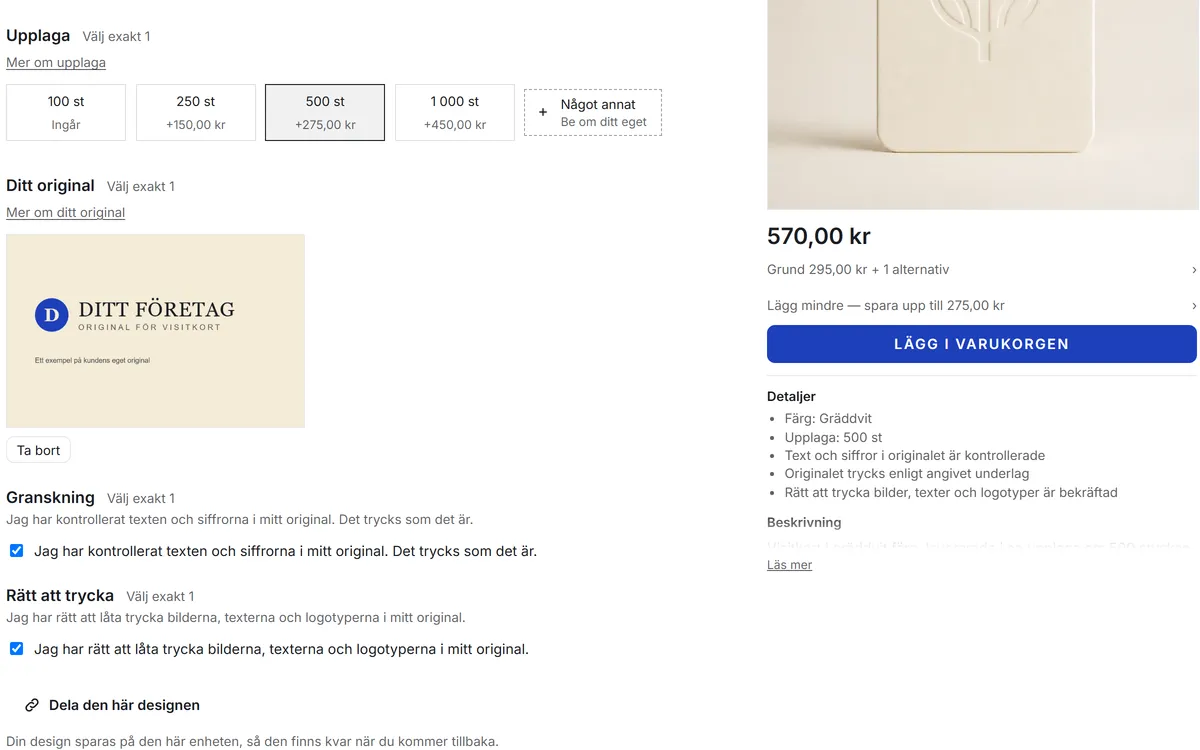
From the print demo store: the run is chosen with its price. The customer's artwork is uploaded with the order. The order waits until the customer has confirmed their file. In the trade
A fault in the file stops the job
Under the trade's terms, a printer must tell the customer of faults in their material. The job can wait until the customer answers.
In Specify
Confirmed before payment
A custom order can wait for the customer to confirm it before payment is taken. This confirms the order. It is not a proof of the artwork.
In the trade
Who pays for a reprint turns on whose fault it was
A print that is wrong is made again, or its price is cut. Under the trade's terms, a fault in the customer's own file is the customer's. An error they did not mark for correction is not the printer's defect.
In Specify
The file kept, and a claim answered with a remake
The file the order was made from is kept with it for two years. A claim against an order can be answered by making it again.
In the trade
The run is part of the contract
The trade's terms treat the quantity as agreed. A delivery a few percent over the run is charged at the following price. A short one is a defect.
In Specify
Prices that follow the run
A product can be priced in tiers by quantity. The highest tier the order reaches sets the price of each copy. The customer sees the tier's price in the cart.
In the trade
A sign has limits a print does not
In Denmark, an advertising sign in open country is barred. In Sweden, a facade sign can need a permit. The permit is the customer's to get. But it decides the size, the lighting and the place of the sign.
In Specify
What you will not make, refused with a reason
The sizes, materials and quantities you will not make are recorded once. A customer who chooses one is told why. What you cannot answer at once is kept as a request for your reply. The permit stays the customer's.

Print or make signs to order?
Give us your website's address. We build a preview of your store from the products on your website. Nothing is charged. We also take 3 founding partners in each sector. We build with them on their real demand.
Sources
Public sources for the rules and practice above.
- Grafiska Företagen, standard terms for graphic work, ALG 20 (Sweden)
- Grafiska Företagen, guidelines for delivering digital production material (Sweden)
- Large Format Review, the Ghent Workgroup's specification for sign and display
- Directive 2011/83/EU on consumer rights (EU)
- Directive (EU) 2019/771 on contracts for the sale of goods (EU)
- Miljøstyrelsen, guidance on advertising in open country (Denmark)
- Boverket, the planning law changes of 1 December 2025, permits for signs (Sweden)